
Every company has social responsibility. ISO 26000 provides guidance on how to address it.
ISO 26000 provides a framework to integrate social responsibility into management practices, align actions with stakeholder expectations and move beyond isolated initiatives and basic compliance.
Our history with companies with purpose
Scott Lane brings nearly two decades of specialised expertise to Speeki’s ESG and sustainability services.
Since 2020, Scott and the Speeki team have been entirely focused on ESG and sustainability, providing the trust stakeholders need to believe what companies share with them.

ISO 26000 was not designed as a certifiable standard but as a guidance document on social responsibility. Speeki has developed a model that allows organisations to obtain a conformance statement demonstrating alignment with all ISO 26000 guidelines.

Speeki’s added value
AI-driven software to manage your social responsibility system in line with ISO 26000
ISO 26000 certification process explained
-
Beginning your ISO 26000 social responsibility work starts with understanding how your organisation currently addresses its societal impacts across the seven core subjects: organisational governance, human rights, labour practices, environment, fair operating practices, consumer issues and community involvement.
The first step is a structured gap analysis that reviews current practices against ISO 26000 guidance. This includes stakeholder identification and engagement, determination of material issues, integration of social responsibility across operations and how impacts are managed throughout the value chain.
This initial assessment often shows that activities such as environmental sustainability, labour practices, ethical sourcing and community engagement are managed in silos, without consistent strategy or governance oversight.
ISO 26000 provides a holistic framework to bring these activities together into an integrated approach to social responsibility. It supports systematic alignment with stakeholder expectations and helps demonstrate commitment that goes beyond basic compliance.
Organisations typically use ISO 26000 to respond to investor ESG scrutiny, strengthen stakeholder trust, manage supply chain responsibility and demonstrate leadership in social responsibility. The outcomes include improved credibility, reduced social and environmental risks, stronger employee engagement, better access to responsible procurement opportunities and clearer accountability to investors, customers, employees, communities and civil society.
-
Implementing ISO 26000 effectively requires cross-functional understanding that goes beyond traditional CSR or compliance roles. Teams need to understand how social responsibility integrates into business strategy, operations, supply chains and stakeholder relationships.
Sustainability professionals, HR leaders, procurement teams, operations managers, community relations staff, legal counsel and senior executives all play important roles. In practice, they often lack a shared framework for identifying relevant issues, engaging stakeholders, setting priorities and integrating social responsibility into decision-making.
Speeki’s intensive two-day and three-day ISO 26000 training courses are designed to build this shared understanding. The courses guide cross-functional teams through the seven core subjects using practical examples across different organisational contexts and industry sectors.
Participants learn how to map and engage stakeholders, carry out materiality assessments that balance stakeholder expectations with organisational impacts, integrate social responsibility across operations and address sphere of influence, including supply chain responsibility. The training also covers due diligence for human rights and environmental impacts and how to establish a structured management approach aligned with ISO 26000.
The three-day course includes additional modules on measuring social responsibility performance and reporting using GRI, CSRD, IFRS S1 and S2 and other relevant frameworks.
Delivered either on site or remotely, the training creates a shared language across functions, accelerates implementation and strengthens social responsibility culture. It supports a shift away from isolated initiatives towards consistent and integrated practice across the organisation.
-
A critical principle in ISO 26000 implementation is maintaining focus on material issues – the social responsibility topics where an organisation has its most significant impacts and where stakeholder expectations are highest.
Not all seven core subjects require the same level of attention for every organisation. A technology company’s material issues may centre on labour practices, data privacy and digital inclusion, while a mining company will focus more on community impacts, environmental restoration and indigenous rights. ISO 26000 emphasises understanding your sphere of influence and directing effort where meaningful impact can be achieved.
This requires structured stakeholder engagement to understand expectations and concerns, alongside impact assessments to identify where operations and value chains create significant social and environmental effects. Social responsibility priorities should then be set accordingly.
High-impact issues with strong stakeholder concern require comprehensive management approaches, appropriate resource allocation, clear governance oversight and transparent reporting. Lower-materiality topics should receive proportionate attention. For example, a garment manufacturer must address labour practices and supply chain conditions in depth, while a professional services firm will place greater emphasis on fair operating practices, employee wellbeing and community contribution.
This materiality-based approach should apply throughout implementation. Stakeholder engagement should focus on affected groups, due diligence should prioritise higher-risk areas and performance measurement should track indicators that reflect material impacts rather than covering all topics equally.
Organisations that maintain this discipline avoid unfocused initiatives that dilute impact and reduce the risk of overlooking critical issues that may lead to stakeholder backlash, regulatory scrutiny or reputational damage. Regular reassessment of materiality helps ensure that social responsibility priorities evolve as the organisation changes, stakeholder expectations shift and new societal issues emerge.
-
The difference between successful ISO 26000 assessment outcomes and problematic results usually reflects how thoroughly social responsibility is implemented across the organisation, rather than being confined to isolated CSR functions.
Organisations often invest months developing policies and programmes, only to uncover critical gaps during assessment. Common issues include stakeholder engagement that is superficial rather than meaningful, materiality assessments that lack depth or stakeholder input, social responsibility principles that are not reflected in decision-making, limited consideration of sphere of influence within the supply chain and governance oversight that is formal but not effective.
Speeki’s pre-assessment services are designed to identify and address these issues early.
A comprehensive gap analysis reviews your approach against ISO 26000 guidance, highlighting weaknesses such as incomplete stakeholder engagement, underdeveloped materiality processes, poor integration into operations, limited supply chain responsibility and governance gaps that would raise concerns during assessment.
This is followed by mock assessments that mirror the actual evaluation process. These include interviews with employees and stakeholders across functions, reviews of policies and implementation evidence, examination of decision-making processes and testing how social responsibility is embedded in day-to-day operations.
The process identifies not only documentation gaps but also implementation readiness issues, such as policies that are not applied in practice, stakeholder engagement that lacks genuine dialogue, materiality assessments that do not inform priorities and governance structures that oversee rather than integrate social responsibility.
Detailed findings and clear remediation guidance allow organisations to strengthen implementation in a structured way before formal assessment. For organisations with complex operations, extended supply chains or lower social responsibility maturity, this preparation significantly reduces risk and supports stronger, more consistent social responsibility performance.
-
The final weeks before your ISO 26000 assessment require careful preparation of stakeholders and evidence across all seven core subjects.
Ensure that social responsibility documentation is complete, well organised and easy to access. Assessors will review stakeholder engagement records, materiality assessments, policies and procedures, implementation evidence, performance data, governance meeting minutes, supply chain due diligence, community investment activities and human rights impact assessments. Delays or gaps can signal weak management or superficial implementation.
Prepare a master matrix that links each ISO 26000 core subject and principle to relevant organisational practices, policies and supporting evidence. This helps demonstrate consistency and makes it easier for assessors to follow how social responsibility is applied in practice.
Plan interviews carefully and select participants who can show how social responsibility is embedded across operations. This typically includes sustainability leaders, operations managers, procurement teams responsible for supplier practices, HR personnel addressing labour issues, community relations teams, product or service managers considering consumer issues and senior executives providing governance oversight.
Assessment logistics should also be planned in advance. Arrange suitable meeting facilities, organise site visits where they help demonstrate operational integration, prepare stakeholder engagement evidence and confirm the availability of key personnel throughout the assessment period.
Brief all participants on what to expect. Assessors will test whether social responsibility is integrated into business decisions or treated as a separate CSR activity, examine understanding of stakeholder concerns and assess whether actions reflect genuine commitment rather than symbolic measures.
Authenticity and consistent implementation matter more than perfection. Assessors expect to identify opportunities for improvement and place greater value on organisations that demonstrate a credible social responsibility culture.
Where appropriate, consider involving key stakeholders in interviews to demonstrate transparency and meaningful engagement. Well-prepared assessments usually run efficiently and are typically completed within three to five days, depending on organisational size, complexity and geographic scope.
-
ISO 26000 assessment follows a structured process that typically spans six to ten weeks from initial review to issuance of a conformance statement.
The preliminary assessment, usually lasting two to three days depending on organisational size and complexity, focuses on a detailed documentation review. Assessors examine the social responsibility framework, including stakeholder engagement, materiality assessment, policies and procedures across all seven core subjects, governance arrangements and implementation evidence, to confirm alignment with ISO 26000 guidance and readiness for full assessment.
Following this stage, organisations receive a preliminary assessment report identifying gaps such as missing stakeholder perspectives, incomplete materiality coverage or weaknesses in implementation. Most organisations require three to six weeks to address these findings, often involving additional stakeholder engagement, refinement of materiality assessments or strengthening evidence of integration into operations.
The main assessment typically takes three to five days and involves a comprehensive evaluation. This includes interviews with employees across functions, stakeholder interviews where appropriate, review of decision-making processes, examination of implementation evidence, site visits and assessment of supply chain responsibility. Assessors focus on how social responsibility principles influence real business decisions rather than existing only in policies.
After the main assessment, the assessment body completes a technical review and approval process, which usually takes a further three to four weeks given the breadth of ISO 26000 evaluation.
Once a conformance statement is issued, organisations normally undergo annual surveillance assessments, typically lasting two days, with a full reassessment every three years.
From initial implementation to assessment readiness, most organisations take between twelve and eighteen months. ISO 26000’s scope across seven core subjects and its emphasis on stakeholder engagement and integration throughout operations generally require more time to mature than single-issue management system standards. Understanding this timeline supports realistic planning, effective stakeholder scheduling and clearer expectation management with senior leadership.
-
ISO 26000 implementation consulting should be delivered by independent consulting firms to maintain assessment integrity. Speeki supports organisations through training, stakeholder engagement support and technology that enable effective social responsibility management.
Speeki’s two-day and three-day ISO 26000 training courses build internal capability to understand, interpret and apply the guidance within an organisational context. The training is designed for sustainability professionals, operations managers, supply chain teams, HR, community relations and senior leaders, providing practical frameworks for identifying material issues, engaging stakeholders and integrating social responsibility into business activities.
The courses cover all seven core subjects using sector-relevant examples. Topics include stakeholder engagement methods, materiality assessment, application of sphere of influence including supply chain responsibility and performance measurement. Training can be tailored to specific sectors and delivered on site or remotely to support consistent understanding across functions.
Beyond training, Speeki supports stakeholder engagement processes that underpin effective ISO 26000 implementation. This includes stakeholder mapping, structured engagement activities, consolidation of stakeholder input and documentation that supports assessment requirements while informing strategy and decision-making.
Speeki's Engage® technology platform supports implementation by managing stakeholder information, tracking engagement activities, documenting materiality assessments, organising evidence across all seven core subjects, monitoring performance indicators and maintaining governance records. The platform is structured around the ISO 26000 framework, helping teams navigate the guidance and maintain focus on material issues.
Together, training, stakeholder engagement support and technology provide a strong foundation for consistent and credible social responsibility management. This allows organisations to work with their chosen implementation partners on strategy development, operational integration and organisational change, while maintaining clarity, structure and accountability throughout the process.
-
ISO 26000 assessment costs reflect the standard’s broad scope across seven core subjects and its emphasis on stakeholder engagement and integration into operations. Pricing follows structured assessment methodologies but typically varies more than single-issue management system standards due to the depth and breadth of evaluation involved.
The main cost driver is the daily assessor rate, which varies by assessment body, assessor expertise in social responsibility and geographic region. The total number of assessment days is determined by the organisation’s profile, including size, operational complexity, number of sites and locations, supply chain scope, stakeholder diversity and overall social responsibility maturity.
A small, single-site organisation with limited supply chain complexity may require four to five assessment days across preliminary and main stages. In contrast, a multinational organisation with complex supply chains, diverse stakeholder groups and operations in multiple countries may require twelve to twenty or more days, including supply chain and stakeholder engagement evaluation.
In addition to assessment fees, organisations should plan for implementation-related costs. These commonly include cross-functional training, stakeholder engagement activities where internal capability is limited, materiality assessment work, supply chain due diligence enhancements and technology platforms to manage documentation and evidence across all ISO 26000 core subjects.
Ongoing costs typically include annual surveillance assessments, usually lasting two to three days, and a more comprehensive reassessment every three years.
Total first-year investment varies widely depending on organisational complexity and existing maturity. Organisations with established ESG or sustainability programmes often find that many elements are already in place, reducing overall effort and cost. Understanding these cost drivers early supports realistic budgeting and more effective planning.

Want to learn more about how to build a social responsibility system aligned with ISO 26000?
Explore our insights to understand the role of the guidelines and how they can be implemented in practice.
Six key reasons to align with ISO 26000
1. Build better social systems.
4. Reduce social and environmental risks.
2. Improve oversight of CSR investments.
5. Improve reputation, integrity and community trust.
3. Meet customer requirements on social investments.
6. Meet increasing ESG reporting requirements.
Need technology to support your social responsibility programme and reduce administrative effort by more than 60%?
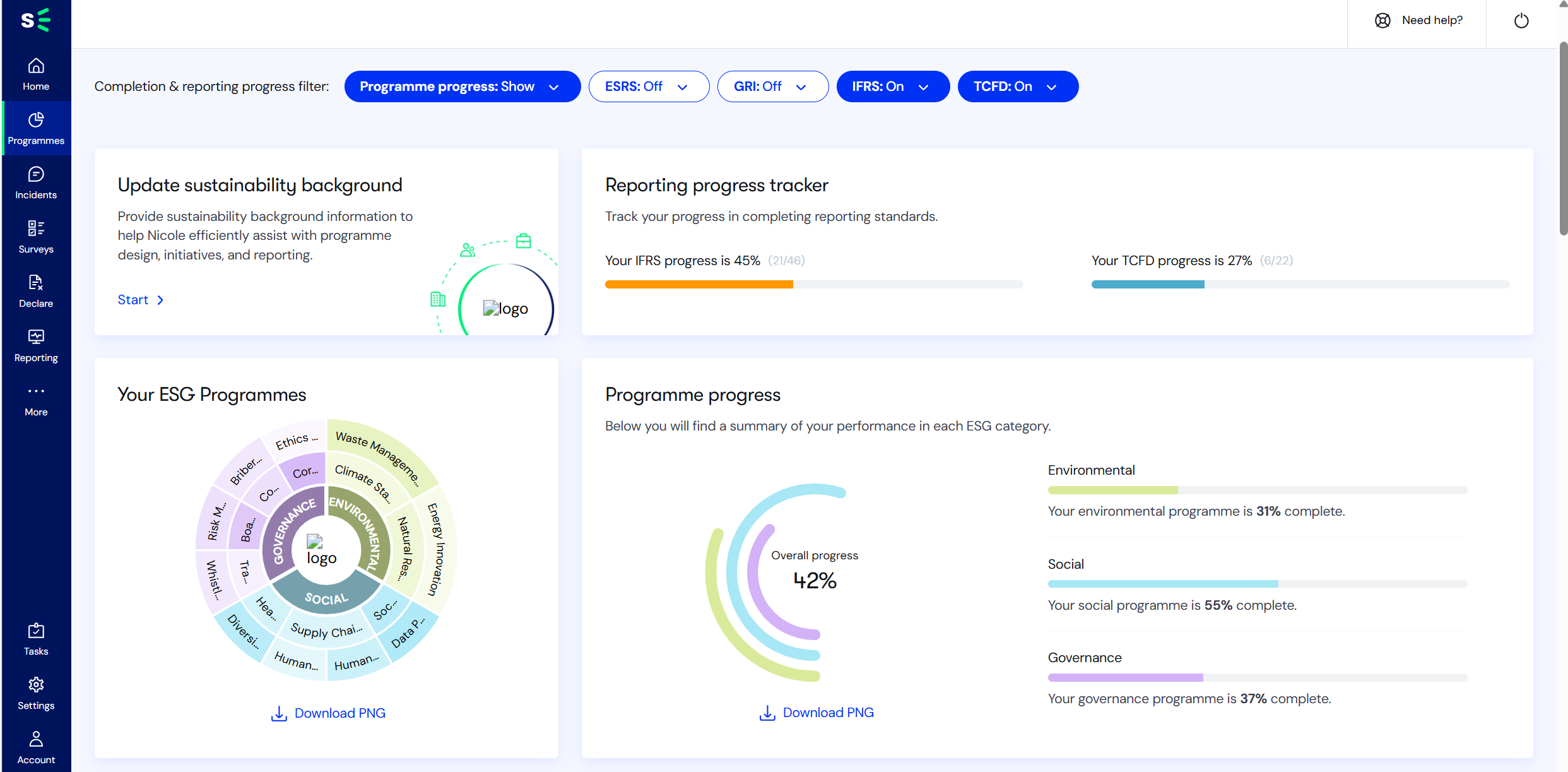
Speeki offers an AI-powered platform called Engage®, available to clients.
Speeki Engage® is structured to align with ISO 26000's social responsibility framework, providing an integrated system that organises activities across all seven core subjects: organisational governance, human rights, labour practices, environment, fair operating practices, consumer issues and community involvement.
The platform replaces fragmented approaches where environmental initiatives sit in sustainability tools, labour practices in HR systems, community investment in separate trackers and stakeholder engagement in disconnected databases. Engage® brings these elements together into a single system where social responsibility activities, evidence and performance data are managed consistently.
Rather than maintaining multiple systems across functions, Engage® presents social responsibility as a connected framework. Stakeholder concerns link to materiality assessments, material issues connect to management responses and performance data is consolidated across all core subjects. This simplifies implementation and ongoing management, supports effective governance oversight and provides clear visibility across material issues.
Engage® includes stakeholder management functionality to track engagement activities, document stakeholder concerns and record organisational responses. It also maintains structured engagement records to support alignment with ISO 26000 guidance.
Organisations using Engage® typically report significant reductions in administrative effort compared with managing social responsibility through disconnected systems, along with improved stakeholder engagement quality and stronger internal coordination.
Most importantly, the platform supports a consistently integrated approach to social responsibility, helping organisations move beyond isolated CSR initiatives towards structured, transparent and accountable management aligned with ISO 26000.
Want to learn more about implementing CSR and social responsibility?
Check out the Speeki Academy.
Gain an integrated assessment by bundling multiple projects to save time and cost.
One audit team. One coordinated project.