
Speeki audits and assures your non-financial performance
From your sustainability report to your anti-corruption programme, Speeki provides assurance your stakeholders can trust.
We use our AI-powered platform Engage® to supercharge assurance.
Speeki is in the trust business. We provide the trust your stakeholders need to have confidence in your non-financial statements.
Financial results are trusted because they are independently audited.
Non-financial results should be no different. Without independent assurance, non-financial disclosures lack the credibility stakeholders expect.
We are rebuilding assurance with AI.
We believe that AI and the digital transformation will disrupt industries and we think audit and assurance should be one of those industries. We are working hard to integrate AI agents (known in Speeki as Nicole®) into every facet of our business. By the end of 2026, we will have more Nicole® agents than employees, driving down cost for clients, improving the audit process and analysis and contributing to the change of an industry caught in 1990.
Our mission is to help clients use assurance as a value driver for their business.
“One partner. One consistent approach. One clear path from assurance to strategic improvement.
Stop managing multiple providers. Build coherent non-financial governance with Speeki as your integrated non-financial assurance solution.”
Scott Lane, CEO and Founder, Speeki
Trust is the most undervalued asset on your balance sheet.
Businesses are built on trust. Trust from the investors who allocate capital to them. From the customers who choose them. From the regulators who permit them to operate. From the communities that accept their presence. From the employees who give them their working lives. That trust has never been more fragile or more consequential.
-
The credibility crisis in corporate sustainability disclosure is well documented and entirely predictable. For twenty years, companies have published sustainability reports with minimal external scrutiny, using self-selected metrics, self-reported data, and narrative framing designed to present the most favourable picture possible. The result is a market in which investors cannot distinguish genuine performance from sophisticated presentation, regulators have been forced to mandate disclosure frameworks specifically because voluntary ones produced unreliable data, and the term "greenwashing" has entered mainstream financial and legal vocabulary as a recognised form of corporate misconduct. The EU, UK, US, and Australian regulators have all taken enforcement action against misleading sustainability claims in the last three years. The era of unverified self-reporting is closing — not because values have shifted, but because the legal and financial consequences of getting it wrong have become too large to ignore.
-
When an independent, qualified third party reviews the processes, data, controls, and claims behind a company's non-financial disclosures and issues a formal opinion, something specific happens: the credibility of the assurance provider transfers to the company's disclosure. This is not a bureaucratic formality. It is the mechanism by which a company's sustainability claims become believable to parties who have every reason to be sceptical — investors making capital allocation decisions, banks applying ESG lending criteria, regulators assessing compliance, counterparties conducting due diligence, and courts evaluating evidence. The higher the quality of the assurance provider, the more credibility transfers. A rigorous, independent, professionally credentialed assurance engagement is not a cost — it is the infrastructure on which trust is built.
-
Institutional investors managing trillions in assets are no longer treating ESG data as a parallel information stream to financial performance — they are integrating it into valuation, risk assessment, and engagement strategy. The quality of that integration depends entirely on the reliability of the data. Unassured sustainability disclosures are being systematically discounted. Third-party assured data is being treated as materially more credible. Investors and lenders are specifically asking whether sustainability information has been independently verified, by whom, to what standard, and with what scope. The cost of capital for companies with credible, assured non-financial disclosure is measurably different from those without it. That gap is widening as disclosure requirements tighten and enforcement actions accumulate. Trust with capital markets is not built through investor relations messaging. It is built through the quality of information a company can independently substantiate.
-
Across every major jurisdiction, the regulatory expectation for non-financial disclosure is shifting from self-declaration to verified evidence. The EU's Corporate Sustainability Reporting Directive requires limited assurance on sustainability data, with a pathway to reasonable assurance. The SEC's climate disclosure rules require independent attestation of greenhouse gas emissions. The UK's Financial Conduct Authority is scrutinising sustainability claims made by listed companies and asset managers with increasing rigour. Regulators in Singapore, Japan, Australia, and Brazil are moving in the same direction. The underlying logic is consistent everywhere: mandatory disclosure frameworks are only as useful as the data quality underlying them, and data quality without independent verification is a policy fiction. Companies that have built robust assurance infrastructure are in a fundamentally different regulatory position to those who have not.
-
In a market where every company has a sustainability strategy, a net zero commitment, and a disclosure report, the differentiator is not ambition — it is substantiation. The company that can point to independently assured emissions data, third-party certified management systems, and a documented governance framework for non-financial risk is not just managing regulatory risk. It is building a competitive position that is genuinely difficult to replicate. Customers increasingly require it as a condition of doing business. Supply chain partners are embedding ESG verification into procurement standards. Lenders are conditioning credit terms on it. And as litigation risk around environmental and social claims grows, the ability to produce independently verified evidence of responsible conduct becomes not just commercially advantageous but legally protective. Trust is no longer a soft asset. It is a hard one.
You cannot claim your way to trust. You have to earn it and prove it.
The businesses that will be trusted in the decade ahead are not the ones with the most polished sustainability narrative.
They are the ones whose claims can withstand scrutiny from investors, regulators, counterparties, communities, and courts. That scrutiny is already arriving, and it is arriving simultaneously from multiple directions at once.
Independent assurance is the mechanism through which trust is earned and then made visible. It is how a company signals, with evidence rather than assertion, that its commitments are real, its data is reliable, and its governance is serious.
Speeki exists for this moment providing the rigorous, independent, non-financial assurance that turns a company's sustainability claims into something its stakeholders can actually rely on.
Sustainability is about resilience. If your board and management is not thinking about building a resilient company, then they may be missing an opportunity and breaching their fiduciary duties.
Sustainability is not a values statement. It's how serious businesses are built.
The companies that will dominate the next decade are not the ones with the best sustainability reports.
They are the ones that have genuinely embedded non-financial risk into how they make decisions, allocate capital, and govern themselves.
The language of sustainability has been captured by marketing departments and compliance teams. The substance of it belongs in the boardroom alongside financial performance, competitive positioning, and long-term value creation.
This is not about purpose. It is about survival, resilience, and the fiduciary responsibility every leader owes to the organisation they steward.
Non-financial risk is financial risk. It always was.
The distinction between financial and non-financial risk is a relic of a simpler operating environment. Environmental liabilities are showing up on balance sheets. Governance failures are destroying enterprise value overnight. Social licence failures are shutting down projects that passed every regulatory hurdle.
The insurance market is already pricing physical climate risk into premiums and exclusions.
The businesses that manage non-financial risk with the same rigour they apply to financial risk are not doing it because they are committed to sustainability. They are doing it because the risks are real, the consequences are material, and the board is accountable.
This is not about being sustainable. It is about building a business.
The word "sustainable" has done enormous damage to the seriousness of what it describes. It has been weaponised by marketers, diluted by compliance, and dismissed by the very leaders who most need to act on it.
Strip it away and what remains is a straightforward proposition: the businesses that understand their full risk landscape, that govern themselves with rigour and transparency, that make decisions with long-term consequence in mind those businesses outperform. They attract better capital. They retain better people. They navigate disruption better. They face fewer surprises.
Nature is the next frontier of corporate accountability.
Are you ready?
For decades, corporate environmental accountability focused almost entirely on carbon. Measure it, report it, reduce it, offset it. That era is not ending — but it is being overtaken. Nature and biodiversity are now entering the same regulatory, legal, and financial accountability frameworks that climate has occupied for the last twenty years.
-
Pollination, water filtration, soil productivity, climate regulation, coastal protection — these are not ecological amenities. They are inputs to real economic output.
The World Economic Forum consistently ranks biodiversity loss among the top five global risks by both likelihood and impact.
Businesses that depend on natural systems — directly or through their supply chains — are carrying unpriced, unquantified exposure. That is a financial risk, not a sustainability aspiration.
-
The Kunming-Montreal Global Biodiversity Framework, agreed in 2022, committed 196 nations to protecting 30% of land and ocean by 2030 and to requiring large companies and financial institutions to assess and disclose their biodiversity risks and impacts.
The EU's Corporate Sustainability Reporting Directive mandates disclosure on biodiversity and ecosystem impacts for thousands of companies.
The EU Deforestation Regulation now requires companies to prove that specific commodities — cattle, soy, palm oil, timber, cocoa, coffee, rubber — have not contributed to deforestation before they can be sold in European markets. Non-compliance carries fines of up to 4% of EU annual turnover.
And the EU Nature Restoration Law, adopted in 2024, creates binding restoration targets across member states that will cascade directly into supply chain requirements.
The regulatory architecture is being built at speed. Companies waiting for final rules before acting are already behind
-
The TNFD framework published in 2023 and now being adopted by over 400 leading organisations globally provides the first comprehensive structure for companies to assess, manage, and disclose nature-related risks and opportunities.
TNFD asks companies to assess their dependencies on nature, the impacts they have on it, the risks that flow from both, and the governance structures they have in place to manage them.
Regulators in the UK, EU, Japan, and Singapore are integrating TNFD into mandatory reporting expectations.
-
The same legal machinery now being deployed against climate polluters is being trained on nature loss.
Ecocide legislation explicitly targets mass destruction of ecosystems, flora, and fauna — with criminal penalties attaching to the individuals who authorise it and the corporations that profit from it.
The EU Deforestation Regulation creates traceable supply chain liability.
Courts in multiple jurisdictions are hearing cases in which biodiversity destruction forms part of the harm alleged.
The reputational and legal exposure from documented biodiversity destruction is no longer speculative. It is a documented, growing, and rapidly accelerating category of corporate risk.
-
The emerging nature accountability frameworks — TNFD, CSRD, the Kunming-Montreal targets — all converge on a single requirement: credible, verifiable data about a company's relationship with the natural world.
Self-reported nature disclosures carry the same credibility problem that self-reported carbon data did a decade ago.
Independent assurance is what transforms a disclosure into a defensible position. It is what separates a company that understands its nature-related risk from one that has simply described it.
We focus on making assurance of your non-financial performance a competitive advantage.
We build better workplaces, better employees and better culture.
-
We engage people to drive the non-financial assets of the company forward. We encourage them to think about impacts, risks and opportunities for the business. We push them to achieve international best practices and adopt global standards.
-
We drive a culture across the workplace, suppliers, regulators, executives and customers that recognises that managing non-financial assets creates value for shareholders and stakeholders.
We improve financial and non-financial performance.
-
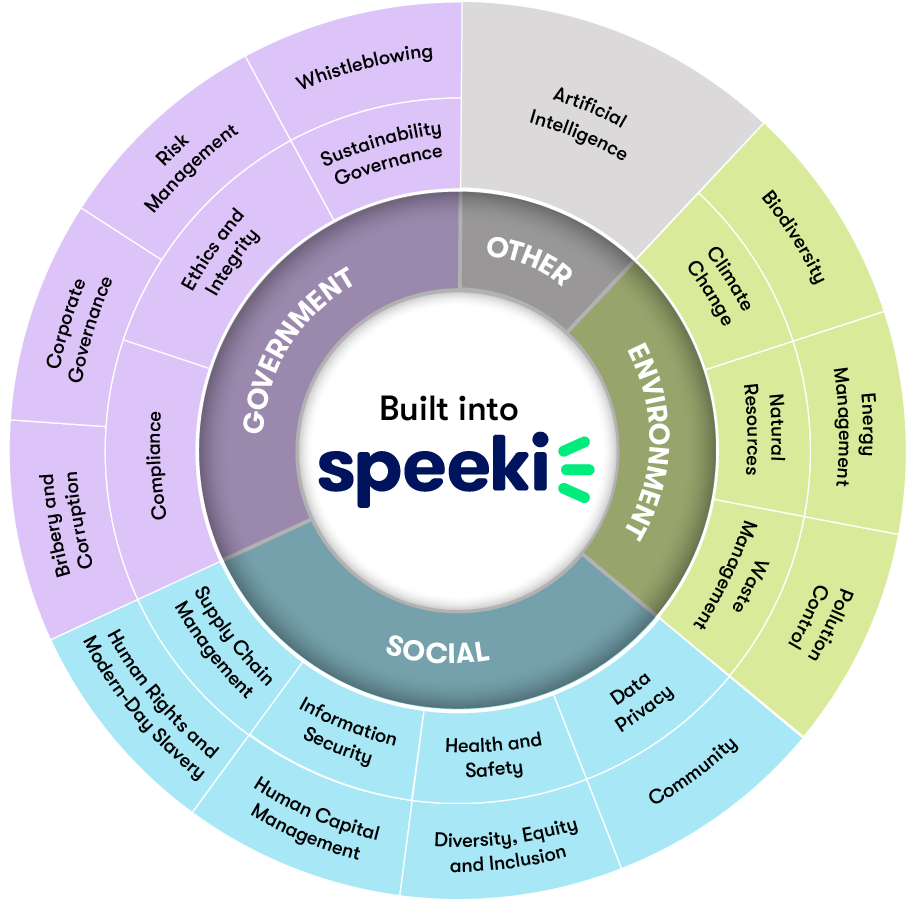
Investors who can trust the assessment of your non-financial assets – including bribery management, sustainability reporting and AI governance systems – are more likely to value higher.
-
Most non-financial assets have a major financial impact if they are underdeveloped, poorly executed or give rise to major crises. Managing these non-financial areas according to international standards will reduce related costs.
We find opportunities to improve, be strategic and lead.
-
Our focus is to drive improvements in your management systems and your internal policies, procedures and controls. We strongly believe our role as an assurance provider is to make you better.
-
Our team are all business experts that have worked in small and large companies for many years. We understand the realities of business and what may and may not be achievable.
Meet Nicole® AI. Our superpower.
Speeki has invested strategically in building our digital workforce.
Nicole®, our AI-powered agent, leads all aspects of ESG and sustainability assurance. Integrated into our Engage® platform, Nicole® delivers value by guiding clients through the development and implementation of comprehensive ESG programmes.
Nicole® is embedded across every function of our business. We have genuinely embraced a digital workforce as core to how we operate.
As a true agentic system, Nicole® is actively involved in client assurance projects. For clients engaged in sustainability report assurance (Speeki Guardian®), this results in faster delivery timelines and reduced costs. We continue to expand Nicole®’s capabilities to deliver greater value to clients.
Drive assurance rather than letting it drive you
In our 15 years of working on assurance matters, first in the anti-bribery space and now across the broader ESG and sustainability market, one thing has become clear and remains true today.
Companies that wait for a crisis before addressing remediation and improvement through audit and certification always pay more, take longer, experience significant organisational stress and almost always face leadership change midway through the process.
Don’t be that company. With basic preparation and by following our five-step process, you can drive assurance.
Suffering from sustainability anxiety?
Most clients are dealing with incomplete or missing data and concerns about possible misrepresentation or greenwashing. That is understandable.
Many are anxious about receiving a call or email from a customer, a journalist, an NGO, an investor or even a board member challenging their sustainability messaging.
We understand. We are here to help. We give you confidence that what you produce is complete and trusted.
Not sure where to start? Overwhelmed about what to do next?
If you are new to ESG and sustainability or to assurance, we have built a five-step process to help.
If you are feeling anxious about your ESG and sustainability work and need a partner to guide you, please reach out.
We will walk you through each step.
Speeki can help!
Need verified emissions data?
Need your sustainability report assured?
Want to achieve ISO certification?
Want to label products with sustainability features?
Can you afford assurance for your non-financial assets?
Use our AI-powered platform Engage® to supercharge your assurance system.
Better performance through better assurance.
As an independent assurance body, our only goal is to validate your performance and show where improvement is needed year after year. We demonstrate to stakeholders that what you report is accurate and trustworthy.
Case examples
“Assurance builds trust.
Great assurance builds trust and value.”
— Scott Lane, CEO of Speeki and Lead Auditor in Speeki’s ESG and sustainability practice
Looking for training?
Speeki Academy offers hands-on training across key areas, including ESG and sustainability, corporate sustainability due diligence, governance and more, to help you tackle real-world sustainability challenges.
We believe that strong performance in ESG, sustainability and compliance increases shareholder and stakeholder value.