

We built the standard to manage corporate due diligence.

Similar to our position on sustainability management, we noticed the industry was lacking a standard on corporate due diligence management, so we wrote it.
SPK DDMS2000:2026 – the Speeki Corporate Due Diligence Management System standard – is a new, certifiable whole-of-programme due diligence standard, with accredited certification through Speeki.
Scott Lane, CEO and Founder, and Lead Auditor
Why we built a standard and what it seeks to achieve
Speeki is at the forefront of building standards that fill the current gap in the compliance, governance and sustainability industries.
SPK DDMS2000:2026 is the Speeki Corporate Due Diligence Management System standard, a risk-based framework for how organisations vet suppliers, agents, partners and every third party they do business with.
Certifiable through Speeki Sentinel.
The standard institutionalises due diligence across the company as a core skill, allowing you to manage risk and leverage opportunity.
Speeki's corporate due diligence management system standard (SPK DDMS2000:2026) is free to use and access.
In fact, we even give you limited access to our technology platform, Speeki Engage®, to build your due diligence programmes according to the standard.
How to access the Speeki Engage® platform to build your system?
You can add SPK DDMS2000:2026 into 'My Frameworks' within the Speeki Engage® platform for no charge.
Where do we access the SPK DDMS2000 standard?
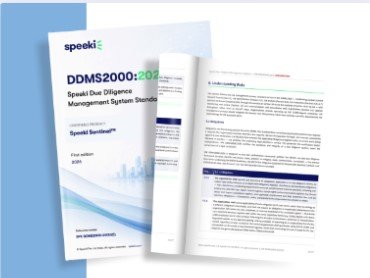
Click on the image to access the standard online.
You can also access it here.
Can you get certified on the standard?
Yes. Welcome to Speeki Sentinel.
For certification solutions on DDMS2000, check out Speeki Sentinel.

No one agreed on what "due diligence" actually means
The law increasingly demands it. Anti-bribery, anti-money laundering, forced labour, sanctions, human rights and environmental law — nearly every major compliance regime of the last two decades leans on due diligence as its central mechanism. Not one of them defines, with real precision, what a company actually has to do to satisfy it.
Into that vacuum, most organisations built whatever was cheapest and fastest to defend: a questionnaire the counterparty filled out about itself, a screening tool subscription, a scoring matrix that quietly buries the one finding that mattered. None of it malicious. Almost none of it, under real scrutiny, defensible.

The real failure isn't the questionnaire. It's what happens after.
Even where due diligence finds something, it often gets overruled anyway — by price, by relationship, by whoever can deliver by Friday. The file sits untouched in a folder. A company that skips the check is at least honest about not looking. A company that runs the full exercise and then disregards it has manufactured a paper trail that makes it look like risk was considered — when it was actually noted and ignored.
A higher risk tolerance is a legitimate choice, made deliberately, by people with the authority to make it. Claiming a low tolerance and quietly overriding it case by case is not risk management. It's box-ticking with a signature at the bottom.
The standards are explicitly complementary: domain standards provide depth within each ESG domain; SPK CSMS1000:2026 provides the governance architecture across all of them.
SPK DDMS2000:2026 covers due diligence across anti-bribery, AML/KYC, export control, sanctions, supplier human rights and environmental due diligence, forced labour and import compliance, deforestation and conflict minerals, personnel and hiring, brand and reputational risk, environmental and health and safety liability, and cyber and data privacy — all governed by one shared risk methodology, competence framework and decisioning structure.
AI-assisted research, third-party vendor management and remediation are addressed as their own dedicated requirements throughout.
A system. Not a policy. Not a vendor. Not a tool.
A policy without competence requirements and a decisioning framework is a sentence, not a system. A vendor relationship without governance over what it's allowed to conclude on your behalf is an outsourced blind spot. A workflow tool that logs what happened is a record — it has no opinion on whether any of it should have happened.
SPK DDMS2000:2026 is a genuine management system standard, built on the same discipline ISO applies to quality, safety and anti-bribery — applied for the first time to due diligence as its own coherent discipline. Risk appetite set deliberately, at governing body level. Evidence standards that scale with risk. Competence that's demonstrated, not assumed. Every override of a finding assigned to a named decision-maker, with reasoning on record.

Eleven risk domains. One governance spine.

Due diligence becomes a capability, not a brake
In most companies, due diligence lives in one or two heads — and walks out the door the day they leave. SPK DDMS2000:2026 institutionalises it instead: a core organisational skill built into procurement, sales, deal teams and HR, not a background task one team quietly owns.
An organisation that trusts its own due diligence moves faster, not slower. It enters a new market with confidence. It closes a deal without a lingering doubt about who it's really doing business with. Due diligence stops being a brake the business resents, and becomes the capability it relies on — to manage risk and act on opportunity, at the same time.

Build to the standard. Certify when you're ready.
Organisations can adopt SPK DDMS2000:2026 and build a conformant due diligence management system entirely on their own. Certification is a separate, optional step: Speeki Sentinel is Speeki's independent verification that your DDMS satisfies every applicable requirement of the standard, a single-outcome, pass or not-pass, with no partial or graduated tiers.
Speeki is an accredited certification body. For current information on Speeki's accreditations, see here.