
 Image 1 of 1
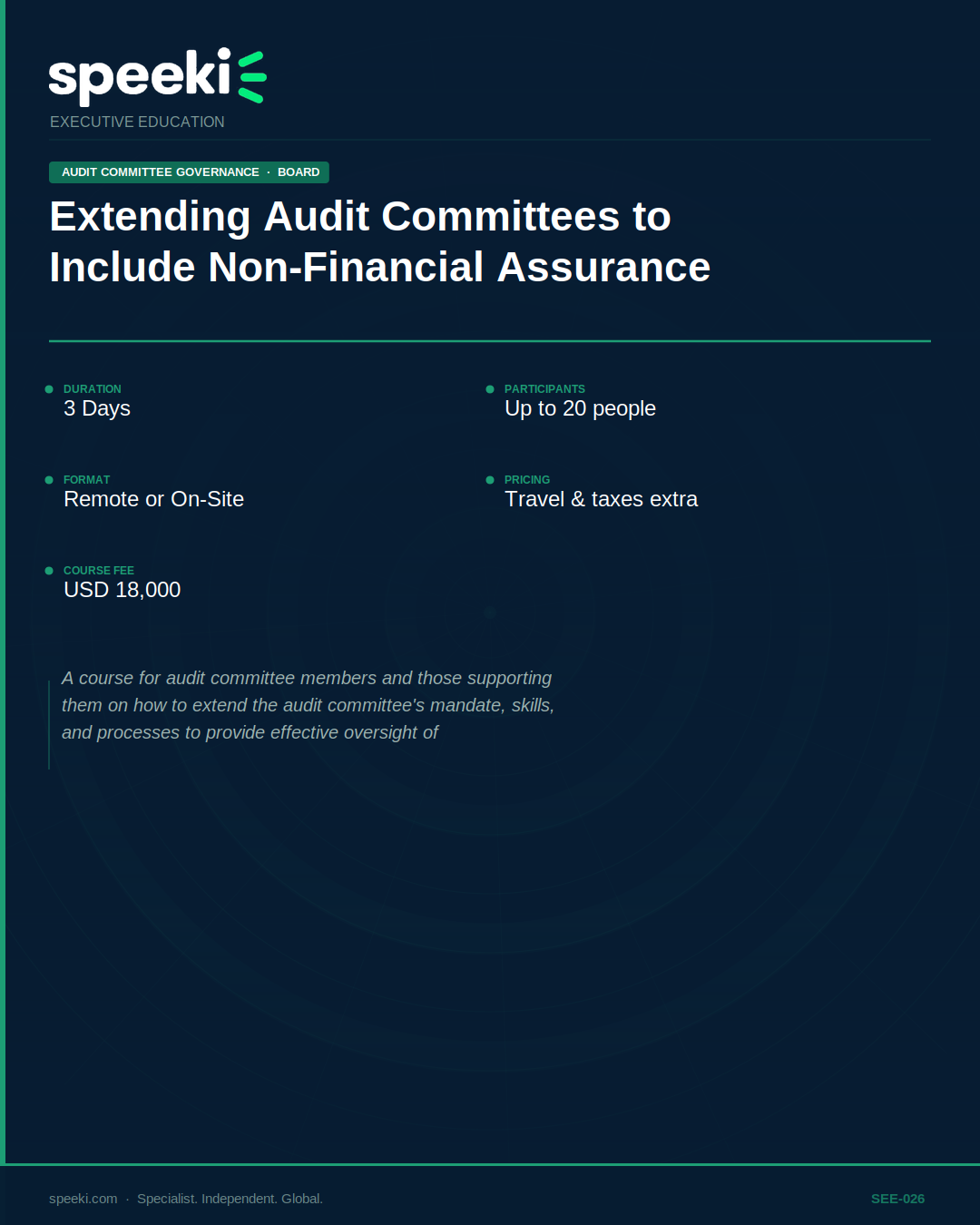
Audit committees were designed for financial assurance. Most are still operating that way. But the assurance landscape has fundamentally changed. CSRD, ISSA 5000, IFRS S1/S2, and TCFD require external assurance over sustainability disclosures that are increasing in scope and materiality. Regulators and investors expect audit committees to own the oversight of that assurance with the same rigour they apply to financial statements.
Most audit committees are not structured, skilled, or informed enough to do that yet. This course addresses the practical challenge of extending audit committee effectiveness to non-financial assurance — not as an additional burden, but as the logical evolution of the audit committee's core purpose. Content covers the current non-financial assurance landscape: what CSRD, ISSA 5000, IFRS S1/S2, and national sustainability reporting regimes require boards to assure and attest to; the structural question — whether to extend the existing audit committee's mandate, create a dedicated sustainability assurance sub-committee, or deploy a hybrid model, with the trade-offs and practical considerations of each; the competence question — what skills and knowledge audit committee members need to provide meaningful oversight of non-financial assurance, and how to identify and address gaps; how non-financial assurance engagements work under ISSA 5000 and AA1000AS, what assurance providers do, what limited versus reasonable assurance covers, and what the audit committee should be reviewing and challenging at each stage; oversight of internal controls over sustainability reporting (ICSR) — the audit committee's role in ensuring management has built adequate data quality and control frameworks before the external assurance provider arrives; how to structure the audit committee's relationship with the sustainability assurance provider, including independence requirements, appointment processes, and challenge protocols; the integration question — how to ensure financial and non-financial assurance are coherent, avoid duplication, and support a single integrated view of organisational performance and risk; and what audit committee reporting on non-financial assurance oversight should contain.
The course uses case studies from organisations where audit committee oversight of non-financial assurance has worked well and where it has failed.
Participants leave with a practical framework for expanding their audit committee's mandate and the confidence to exercise it. Suitable for audit committee members, non-executive directors, company secretaries, CFOs, and those advising or supporting audit committees through the transition to integrated financial and non-financial assurance oversight.
Audit committees were designed for financial assurance. Most are still operating that way. But the assurance landscape has fundamentally changed. CSRD, ISSA 5000, IFRS S1/S2, and TCFD require external assurance over sustainability disclosures that are increasing in scope and materiality. Regulators and investors expect audit committees to own the oversight of that assurance with the same rigour they apply to financial statements.
Most audit committees are not structured, skilled, or informed enough to do that yet. This course addresses the practical challenge of extending audit committee effectiveness to non-financial assurance — not as an additional burden, but as the logical evolution of the audit committee's core purpose. Content covers the current non-financial assurance landscape: what CSRD, ISSA 5000, IFRS S1/S2, and national sustainability reporting regimes require boards to assure and attest to; the structural question — whether to extend the existing audit committee's mandate, create a dedicated sustainability assurance sub-committee, or deploy a hybrid model, with the trade-offs and practical considerations of each; the competence question — what skills and knowledge audit committee members need to provide meaningful oversight of non-financial assurance, and how to identify and address gaps; how non-financial assurance engagements work under ISSA 5000 and AA1000AS, what assurance providers do, what limited versus reasonable assurance covers, and what the audit committee should be reviewing and challenging at each stage; oversight of internal controls over sustainability reporting (ICSR) — the audit committee's role in ensuring management has built adequate data quality and control frameworks before the external assurance provider arrives; how to structure the audit committee's relationship with the sustainability assurance provider, including independence requirements, appointment processes, and challenge protocols; the integration question — how to ensure financial and non-financial assurance are coherent, avoid duplication, and support a single integrated view of organisational performance and risk; and what audit committee reporting on non-financial assurance oversight should contain.
The course uses case studies from organisations where audit committee oversight of non-financial assurance has worked well and where it has failed.
Participants leave with a practical framework for expanding their audit committee's mandate and the confidence to exercise it. Suitable for audit committee members, non-executive directors, company secretaries, CFOs, and those advising or supporting audit committees through the transition to integrated financial and non-financial assurance oversight.