
 Image 1 of 1
ISO 14040 and ISO 14044 together constitute the authoritative international framework for life cycle assessment (LCA) — the systematic methodology for evaluating the environmental impacts of products, services, and systems from cradle to grave.
These standards are the foundation for Environmental Product Declarations (EPDs) under ISO 14025, product carbon footprint quantification under ISO 14067, water footprint assessment under ISO 14046, and EU Product Environmental Footprint requirements. They are increasingly required by supply chain partners, regulators, and investors as evidence that environmental claims are based on rigorous, reproducible methodology rather than selective data.
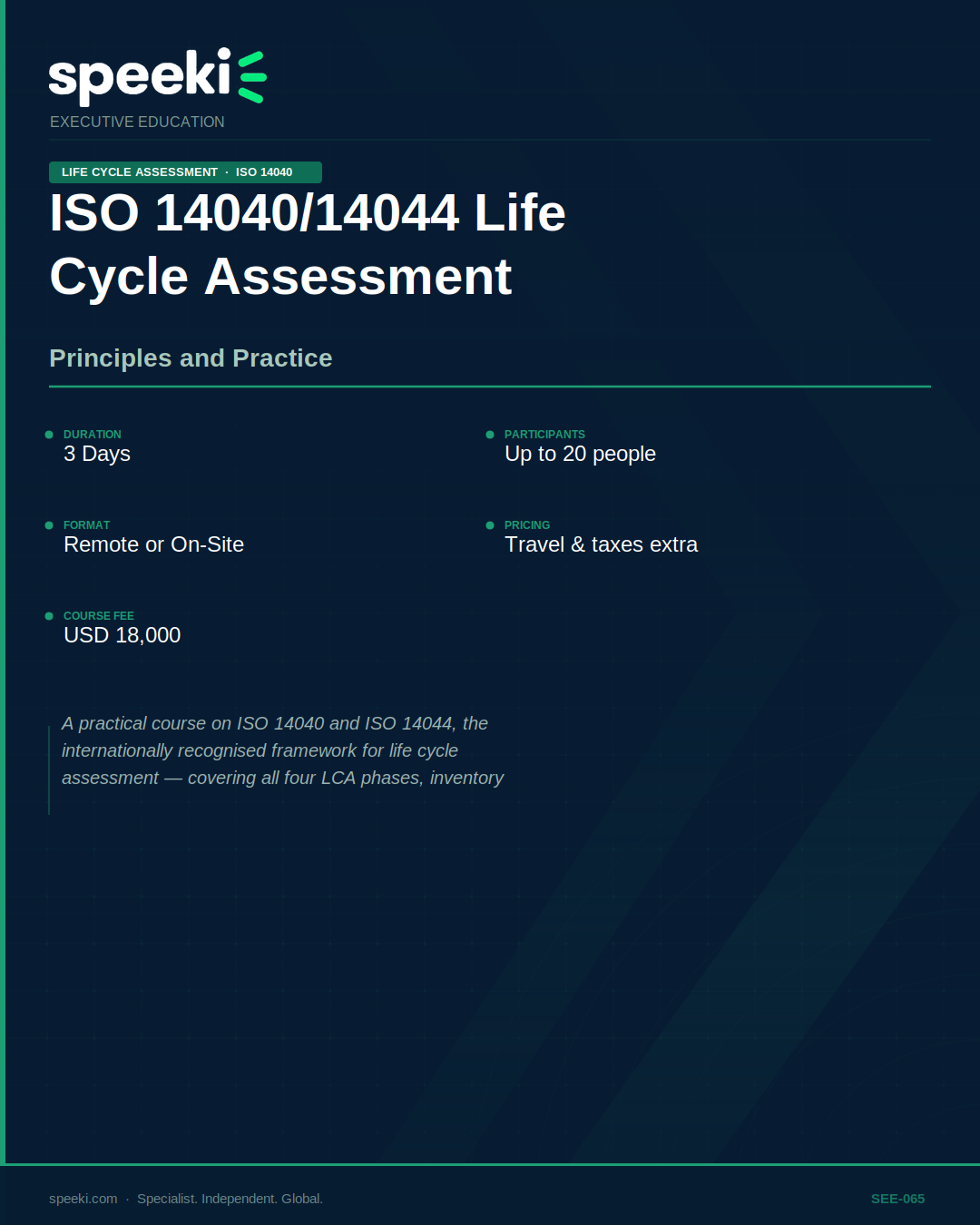
This course develops participants' practical LCA competence across the full ISO 14040/14044 framework.
Content covers ISO 14040 principles and the four-phase LCA framework: goal and scope definition, life cycle inventory (LCI) analysis, life cycle impact assessment (LCIA), and interpretation; ISO 14044 requirements in detail — functional unit specification, system boundary definition, allocation procedures for multi-output processes, data quality requirements including temporal, geographical, and technological representativeness, impact category selection, characterisation methodology, sensitivity and uncertainty analysis, and reporting requirements; critical review requirements — when independent review is mandatory (comparative assertions disclosed to the public), types of review (internal, external, interested party), and what reviewers evaluate; how ISO 14040/14044 connect to ISO 14067 (product carbon footprint), ISO 14046 (water footprint), ISO 14025 (EPDs), ISO 14064 (organisational GHG accounting), and ESRS E1-E5 environmental reporting; practical LCA scoping and inventory exercises using realistic product scenarios; and how to commission, review, and critically evaluate an LCA study.
Suitable for sustainability and ESG professionals, product designers, procurement teams, environmental managers, and those responsible for environmental claims, EPDs, or supply chain environmental data.
ISO 14040 and ISO 14044 together constitute the authoritative international framework for life cycle assessment (LCA) — the systematic methodology for evaluating the environmental impacts of products, services, and systems from cradle to grave.
These standards are the foundation for Environmental Product Declarations (EPDs) under ISO 14025, product carbon footprint quantification under ISO 14067, water footprint assessment under ISO 14046, and EU Product Environmental Footprint requirements. They are increasingly required by supply chain partners, regulators, and investors as evidence that environmental claims are based on rigorous, reproducible methodology rather than selective data.
This course develops participants' practical LCA competence across the full ISO 14040/14044 framework.
Content covers ISO 14040 principles and the four-phase LCA framework: goal and scope definition, life cycle inventory (LCI) analysis, life cycle impact assessment (LCIA), and interpretation; ISO 14044 requirements in detail — functional unit specification, system boundary definition, allocation procedures for multi-output processes, data quality requirements including temporal, geographical, and technological representativeness, impact category selection, characterisation methodology, sensitivity and uncertainty analysis, and reporting requirements; critical review requirements — when independent review is mandatory (comparative assertions disclosed to the public), types of review (internal, external, interested party), and what reviewers evaluate; how ISO 14040/14044 connect to ISO 14067 (product carbon footprint), ISO 14046 (water footprint), ISO 14025 (EPDs), ISO 14064 (organisational GHG accounting), and ESRS E1-E5 environmental reporting; practical LCA scoping and inventory exercises using realistic product scenarios; and how to commission, review, and critically evaluate an LCA study.
Suitable for sustainability and ESG professionals, product designers, procurement teams, environmental managers, and those responsible for environmental claims, EPDs, or supply chain environmental data.