
 Image 1 of 1
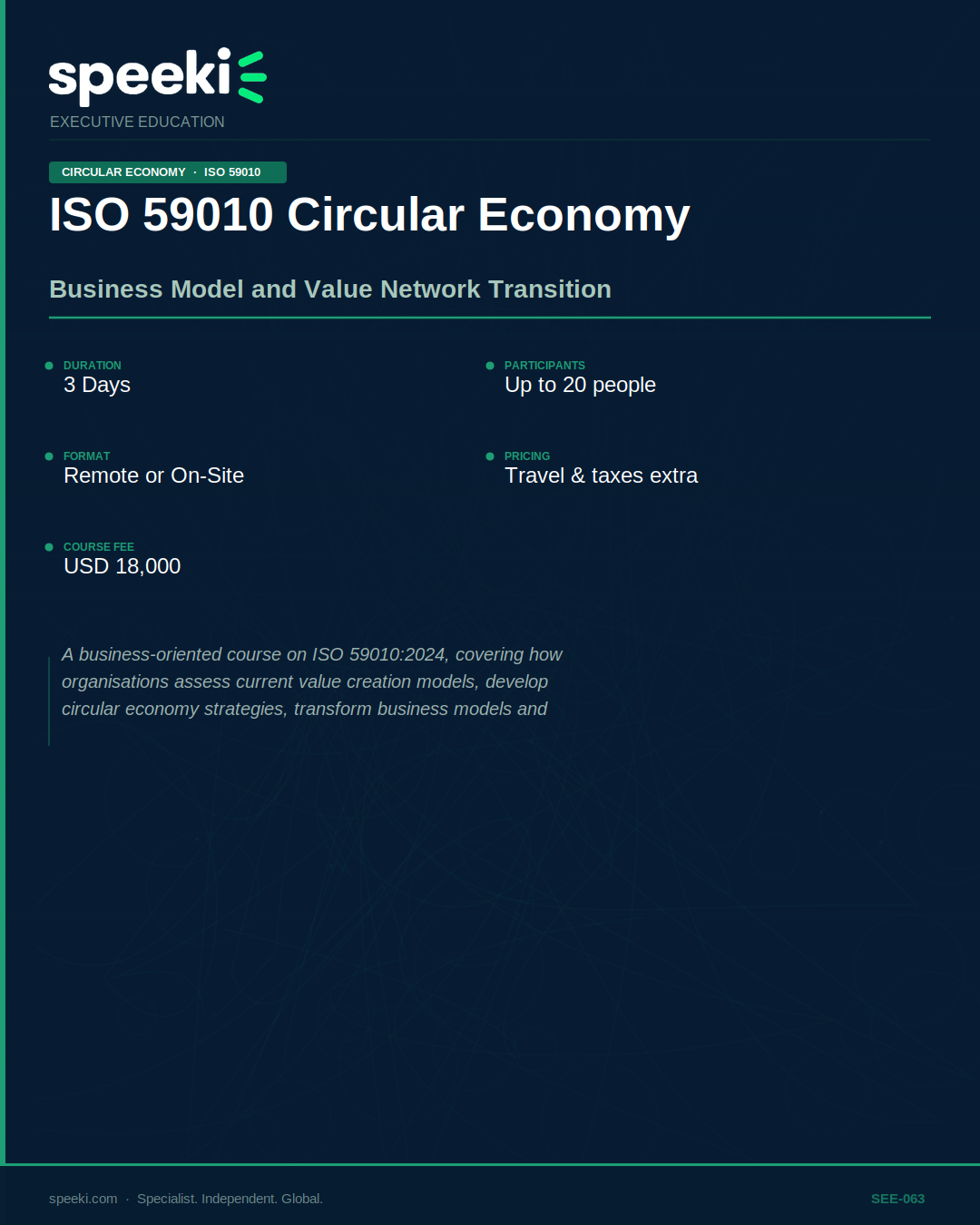
ISO 59010:2024 provides the business-oriented methodology for transitioning organisations and their value networks from linear to circular models, complementing the principles established in ISO 59004.
Where ISO 59004 answers 'what is the circular economy and why does it matter', ISO 59010 answers 'how does an organisation actually make the transition'.
This course develops participants' practical capability to apply ISO 59010 across the full transition cycle.
Content covers the five-step ISO 59010 transition methodology: setting goals and system boundaries, determining a circular economy strategy, transitioning the value creation model of the organisation, transitioning value networks towards circularity, and reviewing and monitoring for continuous improvement; how to conduct a rigorous assessment of current linear value creation models and identify circular economy opportunities and constraints; circular business model archetypes — product-as-a-service, sharing models, leasing, remanufacturing, and collaborative consumption — and how to evaluate which are appropriate for a given organisation; stakeholder mapping and value network analysis, including how to identify partners, suppliers, and customers who are essential to circular value creation; how to set measurable circular economy goals aligned with ISO 59020 performance indicators; the integration of ISO 59010 with ISO 59004 principles, ISO 59020 measurement requirements, ISO 14001 environmental management systems, and ESRS E5 reporting obligations; and practical workshop exercises applying the five-step methodology to participant organisations.
Suitable for strategy directors, business development leaders, sustainability programme managers, operations directors, and those leading circular economy business transformation.
ISO 59010:2024 provides the business-oriented methodology for transitioning organisations and their value networks from linear to circular models, complementing the principles established in ISO 59004.
Where ISO 59004 answers 'what is the circular economy and why does it matter', ISO 59010 answers 'how does an organisation actually make the transition'.
This course develops participants' practical capability to apply ISO 59010 across the full transition cycle.
Content covers the five-step ISO 59010 transition methodology: setting goals and system boundaries, determining a circular economy strategy, transitioning the value creation model of the organisation, transitioning value networks towards circularity, and reviewing and monitoring for continuous improvement; how to conduct a rigorous assessment of current linear value creation models and identify circular economy opportunities and constraints; circular business model archetypes — product-as-a-service, sharing models, leasing, remanufacturing, and collaborative consumption — and how to evaluate which are appropriate for a given organisation; stakeholder mapping and value network analysis, including how to identify partners, suppliers, and customers who are essential to circular value creation; how to set measurable circular economy goals aligned with ISO 59020 performance indicators; the integration of ISO 59010 with ISO 59004 principles, ISO 59020 measurement requirements, ISO 14001 environmental management systems, and ESRS E5 reporting obligations; and practical workshop exercises applying the five-step methodology to participant organisations.
Suitable for strategy directors, business development leaders, sustainability programme managers, operations directors, and those leading circular economy business transformation.