
 Image 1 of 1
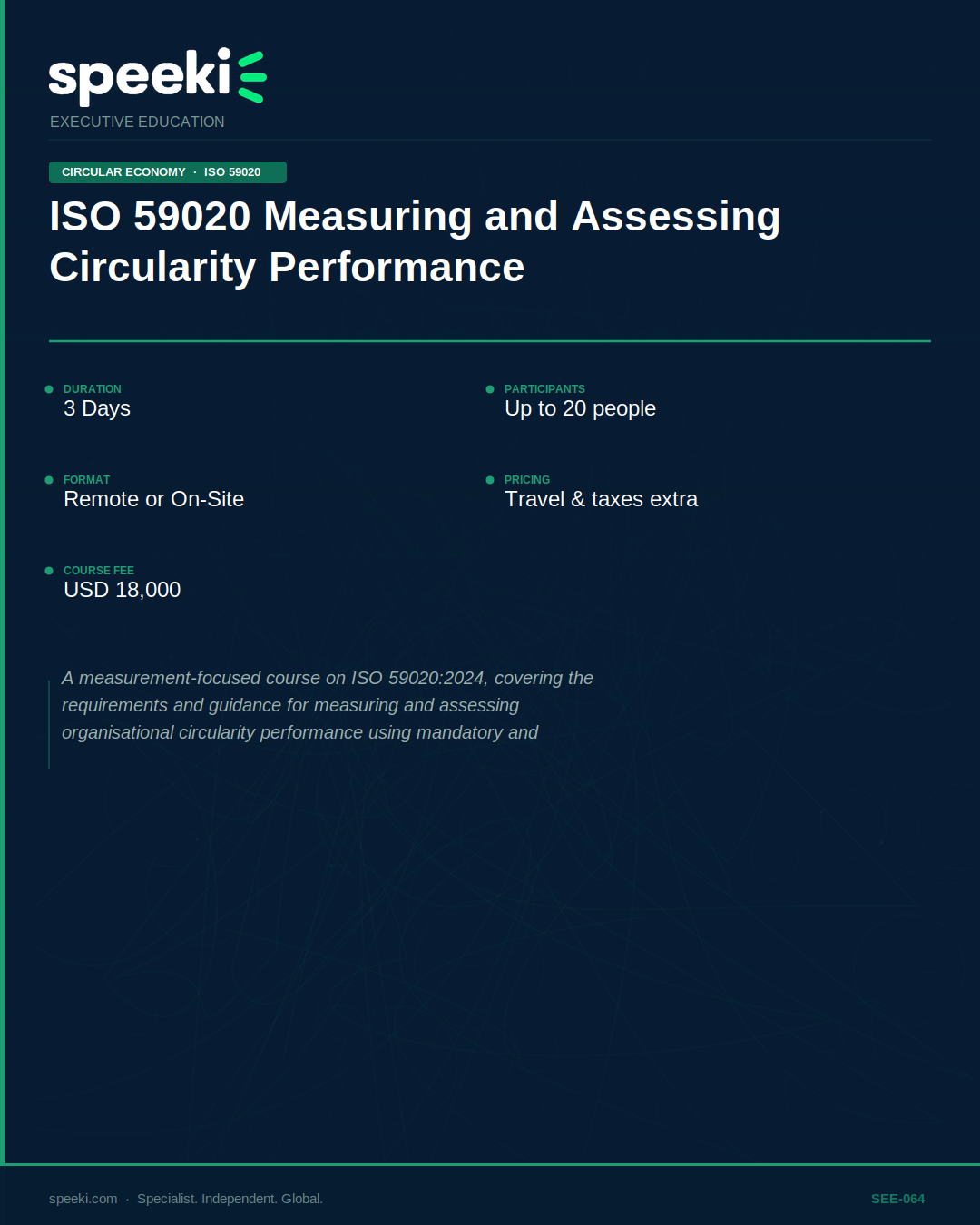
ISO 59020:2024 provides the standardised measurement and assessment framework for circularity performance, giving organisations of all types and sizes a consistent, reproducible methodology for collecting, calculating, and reporting circularity data. It is the measurement standard that makes circular economy claims verifiable — and with regulators, investors, and assurance providers increasingly demanding evidence behind circularity commitments, ISO 59020 is rapidly becoming the benchmark for credible circularity reporting.
This course develops participants' practical capability to implement ISO 59020.
Content covers system boundary setting — the essential first step that determines what is measured and what is excluded; the ISO 59020 indicator framework with 23 circularity indicators across five categories: input flows (material, water, energy inflows), output flows (products, waste, emissions outflows), water management, energy performance, and economic impact; the mandatory and optional indicator structure and how to select indicators appropriate to organisational context; data collection, calculation methodology, and quality assurance requirements; processing and interpreting circularity data to generate meaningful, verifiable results; how ISO 59020 connects to the Global Circularity Protocol (GCP), ESRS E5 (Resource Use and Circular Economy), GRI 301-306 waste and materials standards, and ISO 14001 environmental management; preparing for third-party verification of circularity performance; and worked calculation exercises applying ISO 59020 indicators to realistic organisational scenarios.
Suitable for sustainability data managers, operations teams, finance teams with sustainability reporting responsibility, internal auditors, and those preparing for circularity performance verification.
ISO 59020:2024 provides the standardised measurement and assessment framework for circularity performance, giving organisations of all types and sizes a consistent, reproducible methodology for collecting, calculating, and reporting circularity data. It is the measurement standard that makes circular economy claims verifiable — and with regulators, investors, and assurance providers increasingly demanding evidence behind circularity commitments, ISO 59020 is rapidly becoming the benchmark for credible circularity reporting.
This course develops participants' practical capability to implement ISO 59020.
Content covers system boundary setting — the essential first step that determines what is measured and what is excluded; the ISO 59020 indicator framework with 23 circularity indicators across five categories: input flows (material, water, energy inflows), output flows (products, waste, emissions outflows), water management, energy performance, and economic impact; the mandatory and optional indicator structure and how to select indicators appropriate to organisational context; data collection, calculation methodology, and quality assurance requirements; processing and interpreting circularity data to generate meaningful, verifiable results; how ISO 59020 connects to the Global Circularity Protocol (GCP), ESRS E5 (Resource Use and Circular Economy), GRI 301-306 waste and materials standards, and ISO 14001 environmental management; preparing for third-party verification of circularity performance; and worked calculation exercises applying ISO 59020 indicators to realistic organisational scenarios.
Suitable for sustainability data managers, operations teams, finance teams with sustainability reporting responsibility, internal auditors, and those preparing for circularity performance verification.