
 Image 1 of 1
Most sustainability programmes fail not because the sustainability team lacks expertise, but because the business leaders around them lack enough understanding to engage meaningfully.
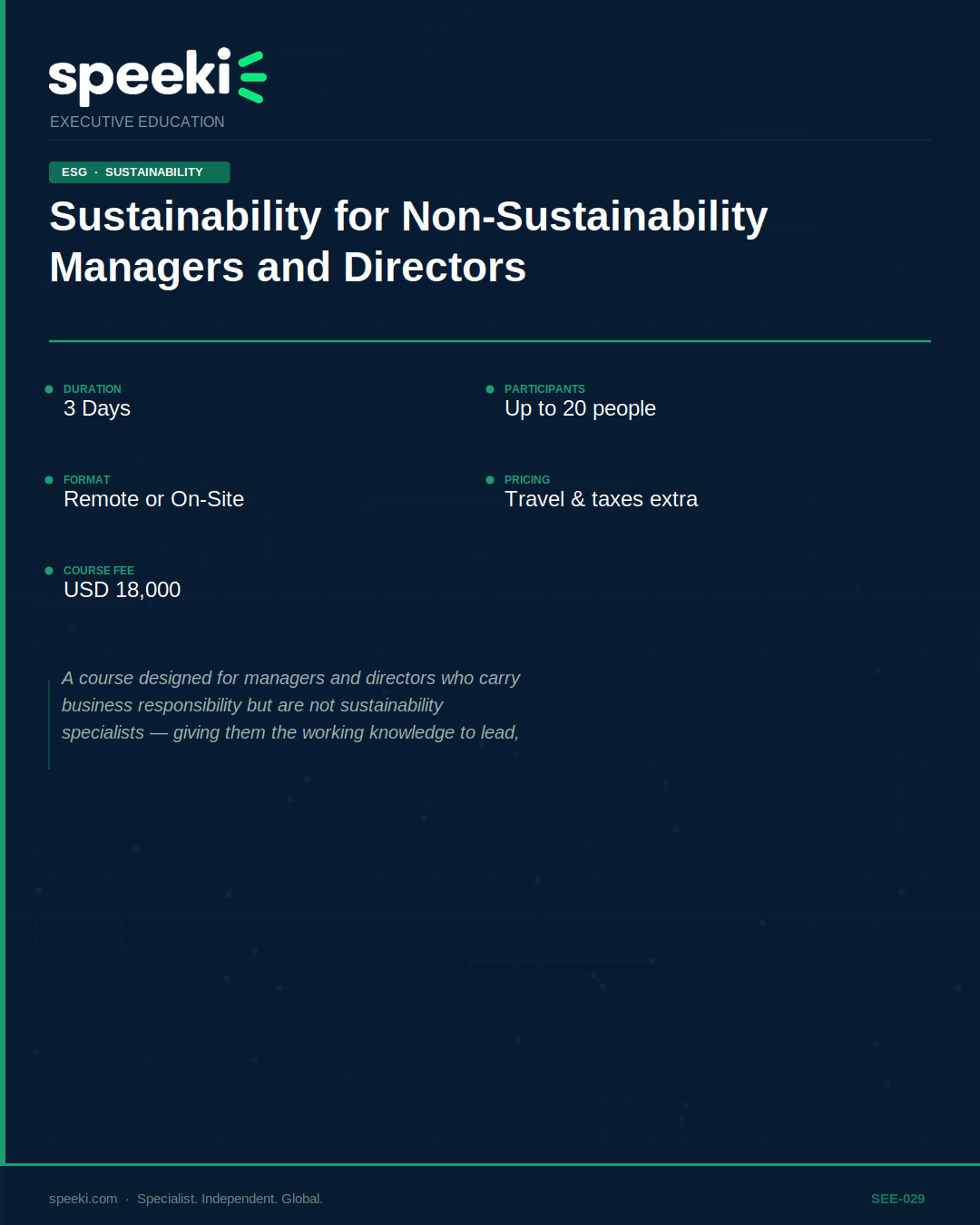
When a finance director cannot evaluate a materiality assessment, a procurement director cannot judge a supplier ESG claim, a board member cannot challenge a net zero commitment, or a general manager cannot connect their operational decisions to ESG outcomes, the programme stalls at the specialist function. This course addresses that gap directly. It is not an introduction to sustainability for beginners — it is a course that gives experienced business leaders a working command of the concepts, standards, obligations, and commercial implications that sustainability now places on their roles.
Content covers what ESG and sustainability actually mean in a business context (stripping away the marketing language), the regulatory landscape and what it requires of organisations and their leaders personally, how materiality assessments work and what they should tell a board, the structure of major reporting frameworks (ESRS, GRI, IFRS S1/S2) and what they demand from non-sustainability functions, how assurance and certification work and what credible third-party verification looks like, climate risk and liability exposure including the emerging science of attribution, supply chain ESG obligations and what procurement decisions actually create in terms of legal and reputational risk, and how to read and critically evaluate sustainability reports and ESG disclosures.
The course is deliberately commercially framed — sustainability as risk management, value protection, and competitive positioning, not as values or purpose.
Participants leave able to engage credibly in sustainability governance, challenge their sustainability teams constructively, make procurement and operational decisions that are ESG-informed, and understand their own personal exposure under emerging regulatory frameworks.
Suitable for finance directors, general managers, operations directors, procurement directors, HR directors, legal counsel, risk managers, and non-executive directors who need working sustainability literacy without becoming sustainability specialists.
Most sustainability programmes fail not because the sustainability team lacks expertise, but because the business leaders around them lack enough understanding to engage meaningfully.
When a finance director cannot evaluate a materiality assessment, a procurement director cannot judge a supplier ESG claim, a board member cannot challenge a net zero commitment, or a general manager cannot connect their operational decisions to ESG outcomes, the programme stalls at the specialist function. This course addresses that gap directly. It is not an introduction to sustainability for beginners — it is a course that gives experienced business leaders a working command of the concepts, standards, obligations, and commercial implications that sustainability now places on their roles.
Content covers what ESG and sustainability actually mean in a business context (stripping away the marketing language), the regulatory landscape and what it requires of organisations and their leaders personally, how materiality assessments work and what they should tell a board, the structure of major reporting frameworks (ESRS, GRI, IFRS S1/S2) and what they demand from non-sustainability functions, how assurance and certification work and what credible third-party verification looks like, climate risk and liability exposure including the emerging science of attribution, supply chain ESG obligations and what procurement decisions actually create in terms of legal and reputational risk, and how to read and critically evaluate sustainability reports and ESG disclosures.
The course is deliberately commercially framed — sustainability as risk management, value protection, and competitive positioning, not as values or purpose.
Participants leave able to engage credibly in sustainability governance, challenge their sustainability teams constructively, make procurement and operational decisions that are ESG-informed, and understand their own personal exposure under emerging regulatory frameworks.
Suitable for finance directors, general managers, operations directors, procurement directors, HR directors, legal counsel, risk managers, and non-executive directors who need working sustainability literacy without becoming sustainability specialists.